Monday, 14 July 2014

Unst wildlife

Unst has a great variety of wildlife and normally at migration tie some great birds pass through. This trip we didn’t see any rare migrants but we did see some other interesting birds such as Gt Northern Diver, Red Breasted Merganser, Twite, Red Throated Diver, Gt and Arctic Skua and Twite
                                                                Red Brested Merganser 

Otters can be seen anywhere around the coast with Baltasound a good spot and if you are lucky the odd Killer Whale can turn up especially in Bluemull Sound.
                                                                                    Twite

We visited the Keen of Hamer again this year, a bit later than normal, first passing Unst Bus shelter which changes its look every year. It’s even got its own website at www.unstbusshelter.com , well worth a look.
At the Keen of Hamer, which is a National Nature reserve, a wide variety of unusual plants can be found on the largest area of serpentine debris in Europe. Here you might find Shetland Mouse ear chickweed; it’s the only place in the world it grows.


                                                                                Frog Orchid
Also Norwegian sandwort, frog, fragrant, common spotted, heath spotted, northern marsh and early purple orchids grow. If you view the area from a distance you wouldn't believe anything was growing it looks so barren.
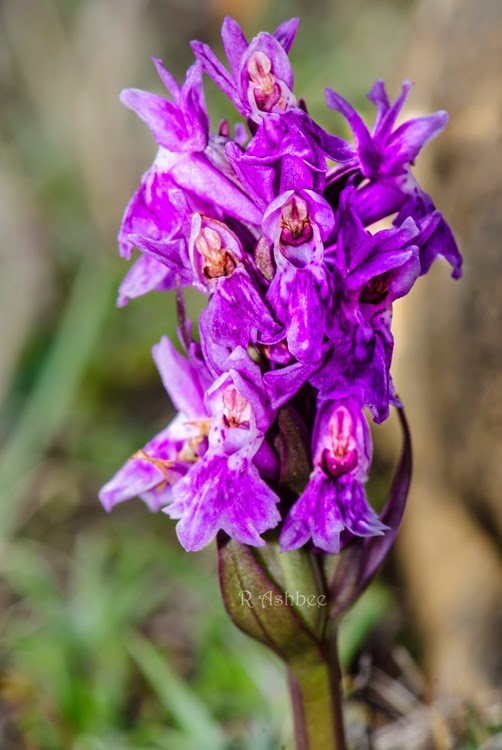
                                                                              Early Purple Orchid
                                                                              Heath Spotted Orchid


On this trip is it was fairly busy with wildlife tours calling in, but they didn’t stay long and then I had the place to myself once again. Even areas outside the reserve are worth a look, especially where they sheep haven’t been grazing. Rabbits also cause damage and get into the reserve despite it being fenced off.


At the very tip on Unst Hermaness NNR is worth a visit, but watch out for the Gt Skuas that dive bomb you. Once you get to the cliffs it’s a mind blowing sight with so many Gannets, Puffin, Fulmar, Guillemot, Razorbill and Kittiwakes in the breeding season as well as the sounds and associated smells.
                                                                                      Gt Northern Diver

After our visit a Lesser Grey Shrike and Pectoral sandpiper, that life !

Wednesday, 9 July 2014

Good or bad

Kittiwake numbers have been declining from a number of years, the sound that was once familiar at Sumburgh, Noss and Hermaness are becoming quieter. In Shetland since 2000 Kittiwakes have declined by 87%  and this is down to the lack of sand eels.
                         
The combination of over fishing an Global warming has seen the sea temperatures increase the sand eels dive deeper making it difficult for surface feeding Kittiwakes to find food. Even Puffins and guillemots are finding it difficult.The RSPB indicate that it wont be long until the Kittiwakes completely disappear as a breeding bird from the cliffs of Shetland.

Oceanic climate change is forcing the marine animals to either change their habits or move away to another area. A recent study for example has indicated that a 2-3% increase in sea temperatures may lead to a 20-30% decrease in marina species. All marina mammals have a limited temperature range in which to live in.  With sand eels the whole process of breeding, feeding, growth, defense and behavior is affect by the increase in the ocean temperature.

The number of new species entering our ocean is increasing as these warmer tolerant  creature start to compete for food or become predators. You only have to look at the prey items that kittiwakes are finding to appreciate that their food source has moved deeper.
                                                          Some Puffins still collecting nest material

The pipe fish that many birds bring are long and have many bones, lacking in protein and difficult for young birds to swallow, with some chocking to death.

Sand eels seem to be moving deeper in the ocean as a result of these effects as a result many birds are now finding this prey item out of their reach.

Man has influenced  the abundance of fish and other marine creatures and it has been estimated that 400 million people depend on fish as a food source. The sand eel fisheries around Shetland had been mainly concentrated around the south mainland, where seabird colonies suffered at Sumburgh, Noss and Noness.

Fishing together with combination of other factors has lead to a big decrease in sand eel numbers which have never recovered. Sand eels are only used for pet food and fertilizers  It is widely understood that the population needs a third of their stock to survive in any given year to support seabird colonies.


 The BTO has studied seabird populations for some time and they indicate that colonies on the west of Britain are fairing better than the east and north coast colonies.  Studies indicate where sand eel fishing has taken place seabirds have been most affected.

Even though sand eels are no longer fished in Shetland, the species is largely sedentary making it difficult for populations to recover. Danish fishing vessels are the only one that still fish for sand eels, but predatory fish such as Cod, Haddock, Whiting and Saithe do have an impact no sand eel numbers and further research is being done

Some seabirds have already responded to the changes in temperature by moving further north. Changes also encourage birds to breed earlier and therefore may not be in time for food prey abundance. We will see over the coming years through various studies how these changes will further effect our seabirds, so for now we have to enjoy the sight and sounds of a seabird colony but scientist have predicted a 2 degree warming of our oceans by 2050.

This year I have noticed a good number of Arctic Terns bringing sand eels back to the nest throughout the season, but only a very few Puffins have been bring food back. The other day down at Sumburgh a few Guillemot young could be seen and some adults with fish.

Lerwick harbour was full of birds with gannets catching good numbers of fish and even Kittiwakes and terns seem to be doing OK. Both Arctic and Gt Skua could be seen chasing birds. Its far too early to say how good or bad the season has been but this is the busiest year for birds with fish for a considerable time.

Thursday, 3 July 2014

Great Skua

The Gt Skua or Bonxie (of Norse origin) has a fierce reputation for attacking other birds and people. This skua is wide spread over Shetland with the highest number on Foula and up on Hermaness- Unst.

My first encounter with a Bonxie was in NW Scotland close to Handa island where they breed. It passed close by giving excellent views. You could see the powerful body especially the neck which was thick. Move on a few years and we saw many on our first trip to Shetland and numerous since. Scotland has around 60% of the worlds population with the majority on Shetland.

This is a dark brown bird with streaking , sometimes golden brown, while the juvenile is warmer brown  un-streaked below. Its flight is very direct and powerful and is quick to move in on any bird or mammal. If you visit an area such as Hermaness then you will have to walk through many territories and therefore will be attacked. Birds will fly head on and do not deviate so your only response is to duck, i have spent many a minute discovering flowers this way.


Birds nest on moorland in colonies, producing two eggs and at this point become more aggressive. The older more mature birds nest higher on the moorland getting better views of intruders while younger breeding birds nest lower down. Birds lay two eggs, spotted olive brown in colour.

Bonxies have a habit of sitting away from the nest  on other mounds(the other adult bird) and often have three or four of these mounts within their territory. Birds don't breed until they are between 5-10 years old so perhaps we may see some decreases in future. They do live along time with a bird over 36 years old

After the have landed, birds have a typical display in which the raise their wings and lift their heads as well as calling.This is a typical stance after an attack.

Feeding is a big problem to most seabirds but for the Gt Skua it has managed to change its diet. Sand eels and fish discards formed a big part of the diet , both of which has declined. Therefore the Gt Skua has moved onto other prey items such as adult birds- Puffin, Guillemot etc , rabbits of which there are plenty in Shetland and eggs. In some years where food is scarce they even turn to cannibalism .

They even attack large birds such as gannets tugging on their wing and forcing them to crash into the sea and then stealing the fish. Even Gt Black Back Gulls are sometimes targeted but they don't have much success as these birds are just as aggressive.

This year birds seem scarce, with two farmers in the south mainland indicating that the numbers are down to 1/5 of what they were last year.

Friday, 20 June 2014

Arctic & Long Tailed Skua Skua

The smaller Arctic Skua or Skooty Alin (Shetland name). is in decline and it is estimated that in the UK only 2,100 or so birds are nesting. 10% of the nesting birds can be found in Shetland.

This bird is reliant on other birds finding food, such as Puffin , Kittiwake and Arctic Terns and it tends to nest close to these. The problem for seabirds is that they cannot find enough food to survive and this has affected numbers of Arctic Skuas.
                                                                     Arctic tern just one of the birds targeted


They can be seen moving fast low over the sea chasing auks and terns, forcing them to disgorge their food and then the skua picks this up, this is called Kleptoparasitism. Some birds are now taking eggs and in some areas small birds.

They come in two colour forms- dark birds & light phase , they breed together but the light phase birds are more common the further north you go.

Around 7-8 pairs of nesting birds used  to be found on Hermaness but it is now down to one pair, although they haven't managed to raise any young for a couple of years. The same goes for birds on Noss and on Mousa. Gt Skuas are forcing these birds out and numbers have dropped by....., Gt Skua taking the best breeding areas and also predating young Arctic Skuas. The future looks bleak as it does for so many of our seabirds.

They are very fast in flight and can be easily told by the narrow pointing wings showing white, a long tail- although short compared to the long tailed Skua

The Long tailed skua is a scarce migrant passing Shetland in May as it heads up to the arctic breeding grounds. An adult male bird did take up territory on Burra for three seasons but did not return during 2013. It seem to associate with an Artic Skua. It would come low to investigate any person in the area.and seem to feed on insects found in a marshy area.


Tuesday, 17 June 2014

Still not over yet.

I thought spring migration was at an end last week but I was wrong. This week I have had a third Icterine warbler, a  common crane up at Eshaness, a Great Reed Warbler (one of two) round the corner from where we are staying and a couple of days ago a Blyth’s Reed Warbler which sang and showed well for a couple of days. Another bird was present at the same time at Scatness


The identification of Blyth’s Reed Warblers are always difficult this was easy as it sang all the time. They breed in NE Europe including Southern Finland in bushy swamps, no swamps here but it did spend all its time in a very dense bushy garden. It resembles a Marsh Warbler, but its rump is slightly rustier colour in tone, the wings more rounded, and the 2nd primary shorter than the 5th- difficult in the field. The bill is longer than the Marsh and the supercilium shorter and indistinct. The song was given from both low down but occasionally high up and is very distinct. I did have a brief view of one last year but over two hours the bird performed superbly.

Unlike the Gt Reed Warbler which was in dense cover beside a burn after nearly three hours it emerged and flew out down the burn onto a branch, gave a brief song then disappeared again. It’s a large warbler with an unmistakable song, which I have often heard in France.

My third Icterine warbler of the spring was in a garden at Grutness in the south mainland, I had been checking this area on a regular basis since we arrived 8 weeks ago so it’s nice to find something unusual. It breeds in Eastern Europe but is a rare but regular visitor to Shetland; in fact this was my third Icterine Warbler of the spring, all giving good views. Having a greenish/ Grey upper part and yellow under parts which distinguishes it from all other warblers except the Melodious Warbler but has blue grey legs.


A Crane was on moorland near Eshaness, its very large grey and cannot be taken for anything else.  I was just stopping but had two cars (rarer than the Crane) on the single track road and had to move forward to the next passing place. When I returned I just managed to see it flying off north, hence no photo.


This may be the last spring record but birds will be returning south on migration very soon- it’s a very short season for some. I am looking forwards to photographing Crossbills which seem to turn up from July on.
Its been good catching up with a few of Shetland specialties such as Whimbrel (above), this is a declining wader mainly found in the northern islands, especially on Fetlar and Unst.

A small number of Hobby have been seen, yesterday at Sumburgh head, at Eshaness and in Unst, this is not a common bird in Shetland, the last one I saw here was back in the 1990's at Hillwell. Other raptors have included a red and Black Kite which just passed through

Friday, 13 June 2014

Spring still going

Spring is still with us in Shetland and migration in full flow. Lots of interesting birds have been passing through the islands adding to the 70 odd species that breed in Shetland. In my last blog I covered some rare birds which I had seen and they continue to arrive with Bee-eater, Golden oriole, Glossy Ibis which is moving regularly between Orkney and Shetland, Rustic Bunting and Blyth’s Reed warbler to tempt birdwatcher to travel north- I haven’t seen these this year but, I have managed to catch up with another Icterine warbler, Gt Reed Warbler, Red Breasted Flycatcher and Crane. I have been out and about seeing lots of common migrants.


                                                     Above Red Breasted Flycatcher at Geosetter

Often birds don’t appear in their normal habitats; Blackcaps move along walls or fences, white throats and lesser whitethroats along streams and Redstarts normally a woodland bird, on cliffs. Every small bird is worth a look, a sparrow can suddenly become a Rosefinch, a Shetland Starling becomes a Rose coloured starling.
Working a patch is the best way to see movement and I have been covering a few locations in the south mainland. This year I have been surprised with the number of Chiffchaff, Willow warbler, Blackcap and Spotted Flycatcher that have arrived

                                                                                     Blackcaps

 Coming up on holiday for a couple of weeks a year can only give you a taster but spending more time in an area always reaps benefits with something unusual turning up.
                                                                        Green sandpiper

Records are important to provide an overall picture of the state of the bird life in Shetland and the Shetland Bird report provides all this information. There is always room for improvement and the number of common birds is under recorded, rare birds always attract a lot of interest. They also do a lot of good work in recording the state of seabird populations which unfortunately is still in decline.
                                                               Cuckoo Hillwell/ Quendale
In addition to sending in bird records I have also started to record Bees, Butterflies and also the location of Polecat Ferrets which seem to be wide spread and abundant.

In Shetland there are not that many birders and those that are here are mainly English, when I have been out and about I have met up with Rebecca Nason (Now in Lerwick), Logan Johnson (Yell) both bloggers, Henry Hyman –another interesting blog from Fair Isle, Jim Wood , Hugh Harrop and Gary Bell who live in the south mainland.

Tuesday, 10 June 2014

Sumburgh Head


Sumburgh Head is one of the most accessible seabird colonies in Britain. It’s easy to see Puffins just look over the wall, they often give close views. They are one of the most recognised birds in the UK, although people often think they are looking at young birds because they are smaller than expected.

On one occasion a couple of Americans arrived in a taxi, looked over the wall and claimed that they were looking at penguins instead of Puffins, they immediately got back in the taxi and left before anyone could tell them they had made a mistake.

This year the Puffin cam won’t be in operation as rabbits have taken over the burrow. Mind you the last three years have seen the young Puffins predated at this site. Numbers Puffins are far lower in number than they were twenty years ago and will continue to decline with the lack of available food.

Other birds such as Kittiwake, Guillemot, Razorbill, Fulmar and Shag are present but in far smaller numbers than when we first visited back in 1987. We did have the good fortune to see a Brunnich’s Guillemot, only the 3rd record for the UK at the time which appeared in the main guillemot colony.

Small birds such as Twite, Starling, Wren and wheatear can be seen and last year I photographed a male Rosefnch. In July don’t be surprised to see Crossbill feeding on the cliffs, not the normal place you would expect to see them.

On Tuesday this week Princess Anne arrived in Shetland to officially open the new RSPB Reserve at Sumburgh head. It was not the best day with fog and rain but at least she could land at Sumburgh airport, if it had become thick fog then the plane may have been diverted to the north mainland. Security was tight and only 250 invited guests were allowed up to the lighthouse area.

                                                        Princess Anne arrives at Sumburgh airport

The lighthouse is the oldest in Shetland, originally designed by Robert Stevenson In 1822. Now In the lighthouse buildings, new interactive displays allow an appreciation of the ocean ecosystem around Shetland. In summer it is possible to see from Sumburgh cliffs, Killer and Minke whales together with dolphins and porpoise.


The £5.4 Million pounds that the RSPB have spent, which were part funded by European money, have now made this the flagship of the society and can only be good to highlight both Shetland and the plight of the seabird population. What can be to stop the decline which is affecting all the Scottish seabirds?. Lessons may be learnt from the stable Welsh populations.


This week I found a dead Puffin on the beach at Levenwick showing that many birds are in poor condition.