Saturday, 11 November 2017

Pied Billed Grebe

I was on my way back from West Voe, having just photographed a small flock of Long Tailed Duck, when the news came in that a Pied Billed Grebe had just been found on Spiggie loch a few miles up the road


Before I made it back to the car news also came in the a drake King Eider had been found at Quarff  about 20 miles north, a bird I have been waiting to see for some years, the last male was at Tresta back in the 1990's


We headed up to Spiggie for the grebe, this was a first for Shetland but I was a bit apprehensive about getting any photos as Spiggie is very big with often distant views of birds.

Arriving at Setter, a small marshy area at the south end of Spiggie we just managed to park in the last space as another couple of cars pulled up. The majority of birders were locals with only the odd couple of visitors.

Roger Riddington had found the bird, he certainly has a knack for finding rare birds.


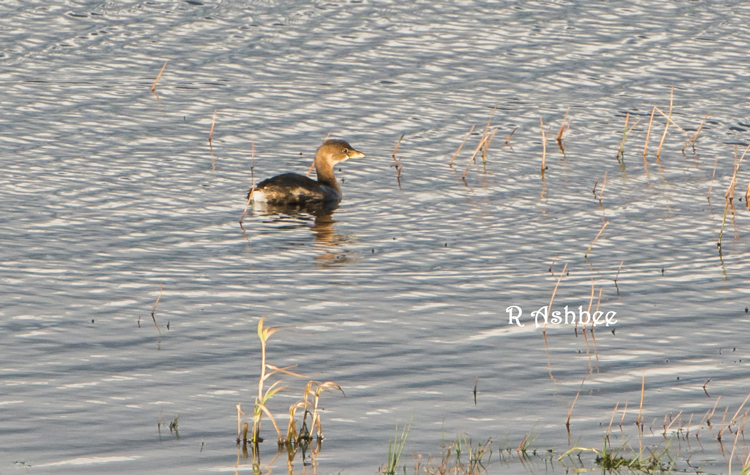
We found the Pied Billed Grebe close into the bank just south of the marsh, this was lucky it could have moved to a more distant part. Although the view was from the road it was still some distance away but even through binoculars it was evident that it wasn't the Little grebe that had been seen in the same area over the past few days.


This rare North American bird was a nice find as things had gone a bit quiet with lots of birds departing. This grebe has a large head with a deep sharp bill, yellow now but in the breeding season this would be white with  a thick black band about half way down.


It caught four fish while we watched it move south before suddenly turning back and heading north. At this stage it was like it had an outboard motor attached moving very fast and moving more towards the centre of the loch.

The grebe is still present in the same area a week later.

At this stage it started to rain so everybody left, I checked about the King Eider but this had been scared off by a motor boat and had flown west.

The following day, both birds were present, the King Eider again for only a short time as the person on the motor boat seemed to deliberately disturb the bird. The grebe although viewable was distant but in the same area

Just to show winter is on us, both Iceland and Glaucous gulls were present at the north end of Spiggie along with around 40 Whooper swan

Jut received the Shetland Bird Report and it was good to find that several of my photos have been used. This is an excellent report and well worth buying.

Saturday, 4 November 2017

Black Redstart

It was nice to find a Black Redstart just down the road at Sanick.in Sandwick.  This male was probably the best marked individual I have seen


I didn't manage to see it on the first visit but I saw it within 5 mins on the second visit inside the cemetery


It jumped on the wall and down into the carpark but by the time I had moved round it had gone

I moved the car round and sat a while in the carpark and it didn't take long before it was seen on the wall, this time for a bit longer. It then moved onto the ground and quickly moved over it to longer vegetation before getting chased off by a migrant Robin.

As most birds do a circuit I found it to the west hopping around on some piles of earth , then back into the cemetery


I quickly re located the bird working its way down a fence line, flying up onto the wire fence every now and again. It seem to find plenty of food on the ground.


It was certainly a good looking male, its mostly female/ juv birds that I have seen in Shetland. Although a male turned Black redstart did turn up to the north side of Sandwick a year or so ago


Black Redstarts tend to be late migrants to Shetland and birds sometimes stop into the long winter months. This one stopped 6 days and I saw it on its last day. The first few days of its stay it was also joined by a second bird

Other Black Redstarts turned up in Lerwick, Hoswick, Sumburgh & Boddam as well as several birds in the north isles. The same day I also saw the Siberian Stonechat down at Swinister but it was very mobile so no photos

The fields  in Sandwick are full of Greylag geese and feeding with these are Golden Plover (350) along with numerous Redwing, Fieldfare and Blackbird.


Other waders in these flocks include Turnstone, Redshank, Curlew, Snipe and Lapwing. A couple of days later, again in the Sandwick area I missed out on the Dusky Warbler at Hoswick, also Blue tit here which is just as rare.

Saturday, 28 October 2017

Fall

The weather finally cleared to produce a clear still day , after a few days of  fog and gales it was good to get out and we decided to head to the south end.

                                                                                                    Song Thrush

On the way down we stopped off at Fleck to see the 4 Barnacle Geese and 13 Pinkfeet feeding with 22 Greylag, winter is coming on fast


Our first real stop was Sumburgh Hotel where a Black Redstart and Yellowhammer had been seen. After a good search we couldn't find either but a large number of Redwing, Fieldfare and Blackbird  had arrived and they were very vocal.

                                                                               Only a few Wheatear left

At West Voe Long Tailed Duck (64) Red Breasted Merganser (6) Gt Northern Diver, Eider (4) Shag (6) . Working our way on foot round to Grutness a few Goldcrest flew up from dense vegetation and in the fields a Song Thrush in addition to the other Thrushes, which were even more numerous here.

On the beach a large mixed flock of waders, around 250 birds was impressive as they flew up from the beach, disturbed by a dog walker. Knot, Sanderling, Redshank, Ringed Plover ,Dunlin, Purple Sandpiper , Oystercatcher and Turnstone


At the garden only Robin(3) and two more Goldcrest, but beside the first quarry a Ring Ousel with around a dozen Blackbird, Robin (4), Meadow Pipit (6) Twite (25) Hoddie (6) Raven and Rock Dove (8). The rain started to fall as we walked to the second quarry.


A few sheep grazed inside the second quarry but it didn't stop a number of birds feeding. No sooner than I opened the gate when Brambling (4) Lesser Redpoll and Common Redpoll(2), Reed Bunting flew up from a bare patch of ground. Here Robin (10) Blackbird (12), some singing was a welcome sight as the rain fell for another 10 mins.


Fulmar (numerous) Hoddie Wren and Twite (30).  and a chaffinch made up the cast. It was good to see Paula and Helen out photographing as well and they were pleased to be shown the Redpoll.


                                                                        Showing signs of a Lesser Redpoll


In addition to the other migrants, several Blue Tit & Gt Grey Shrike have arrived with two Firecrest , a Humes Warbler on Foula, Steppe Shrike on Whalsay, half a dozen Arctic Redpoll on Unst and a White winged Scoter initially on Yell then Unst provided a good end to October