Last weekend i was busy all day Saturday so when Sunday arrived we headed down to Quendale where a Bluethroat had been reported six days earlier. Autumn migration is different to Spring migration as birds are not in such a hurry to leave an area. They have to refuel and if enough food is locally available then they may stay awhile, that was the hope anyway.
Arriving at the farm i met David Gifford who said he was just about the walk up to the quarry where the bird had been seen a few days before. A few other birders came and went, while others made their way up. At least today the cattle would not block the way. Quendale recorded a Thick Billed Warbler last week so you never know what is going to turn up.
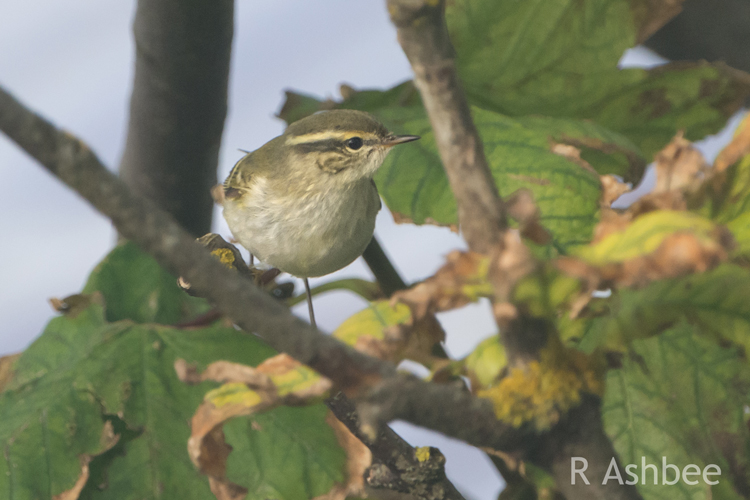
A look in the bushes revealed three Yellow Browed Warblers, numbers are still very high for this species. A couple of ticking Robin was also very welcome - a rare breeding species in Shetland. On the way up lots of Raven, Herring and Gt BB gulls flew over, while a flock of 70 meadow pipit keep pace with us.
The Bluethroat was seen on arrival which was good and we settled down for a prolonged look. This used to be a bogey bird for me in England, missing a few by 10 mins or so, but since moving to Shetland I have had very good views in Spring and Autumn.
This bird performed very close to the admiring viewers, moving across vegetation several times before jumping up into a bush, posing for photos before headed over over our heads. It really deserved a round of applause from the small group of birders.
The bird didn't return in the hour so I set off up the track to view another place it had been seen, but no luck, others search the iris bed but nothing. I headed back to the car , greeting several small groups of birders keen to see this stunning bird- with `no sign' signalling a bit of annoyance in a few people, especially with a couple of birders who had just come down from Unst only to find that a Swainson Thrush had just been located where they had searched just a few hours before.
We headed south to Sumburgh head where two groups of birders stood, one looking out to sea the other staring at some rough grass. a scan of the area revealed a Lapland Bunting a nice bird to see, then word came across - Whales and dolphins.
A mass rush to the cliffs just in time to see a couple of Minke Whales and a couple of Porpoise in the distance while another Minke could be seen near Scatness. Things settled down so most went back to see the Lapland bunting until a shout of Dolphins
This time 5 Risso's Dolphins could be see close to the base of the cliffs moving to the west, a superb sight - everyone giving a cheer. News came to us later that at least 150 Porpoise had been seen near Mail beach in Mousa Sound, another good feeding area for cetaceans.
What a day, and even though the light was poor the wildlife certainly came out to brighten things up.
Tuesday, 6 October 2015
Wednesday, 30 September 2015
Don't trust them
Bad news after bad news this week. First came the news that Shetland could be surrounded by a massive offshore wind farm. Five vast areas of sea, outside the 12 mile Scottish Zone , will be developed around the islands between 2020- 2030 but may be fast tracked.
The biggest is just over 1,000 sq miles is between Whalsay & Sumburgh, with a further 670 sq miles of turbines off Eashaness and other smaller areas. Up to now it was not thought viable to erect turbines in hostile waters around Shetland. But Norwegian technology may have brought the day closer as they hope to have free floating turbines about 12.5 miles off Aberdeen in the very near future.
Wheatear
A full write up can be found here:
I did see the plan about 5 years ago in the Shetland Times, they would still need the interconnector so lets hope the cost will be too high. Whereas the government said it would consult the public with onshore wind farms, offshore wind farms are not included.
Then it just goes to show that SSSI's don't mean a thing when news came out that the government had just released proposals to start fracking at the RSPB reserve at Bempton Cliffs, that's one of 300 wildlife sites the government said it would protect. These wildlife sites now come under threats from 159 inshore oil and gas licenses issued by the government last month. Nine RSPB reserves are included.
Anyway onto the good stuff, at least 123 Yellow Browed Warbler, 4-5 Blyth Reed Warbler, Bluethroat (2), Pechora Pipit and many other good birds on Tuesday. Also invaded by many birders/ twitchers.
Yellow Browed Warbler
Most behave OK but some just cannot wait for the bird to appear and there has been several instances where people have rushed in the flush a very tired bird. All it needs is a bit of patience. At the weekend I was watching a couple of Yellow Browed warbler when two cars pulled up. They had just arrived and needed these birds to kick start the holiday so a couple went into a private garden to flush the birds which they did and they flew off so they wouldn't have got a good view anyway. they were quickly back in the car and headed up to Sumburgh Head.
Willow Warbler
Yellow Browed Warbler
They didn't care it was a private garden or that I had just spent over an hour photographing them, or to the other person watching. The other person i was with said he never reported any birds until after he had left Shetland so he wouldn't be responsible for causing the bird harm.
I remember another Shetland birder at Quarff who stopped writing his blog due to the actions of inconsiderate twitchers who had obviously been reading it to gain information.
Flava Wagtail
The biggest is just over 1,000 sq miles is between Whalsay & Sumburgh, with a further 670 sq miles of turbines off Eashaness and other smaller areas. Up to now it was not thought viable to erect turbines in hostile waters around Shetland. But Norwegian technology may have brought the day closer as they hope to have free floating turbines about 12.5 miles off Aberdeen in the very near future.
Wheatear
A full write up can be found here:
http://www.shetlandtimes.co.uk/2011/05/27/five-sites-identified-around-shetland-for-possible-offshore-windfarm-development
I did see the plan about 5 years ago in the Shetland Times, they would still need the interconnector so lets hope the cost will be too high. Whereas the government said it would consult the public with onshore wind farms, offshore wind farms are not included.
Then it just goes to show that SSSI's don't mean a thing when news came out that the government had just released proposals to start fracking at the RSPB reserve at Bempton Cliffs, that's one of 300 wildlife sites the government said it would protect. These wildlife sites now come under threats from 159 inshore oil and gas licenses issued by the government last month. Nine RSPB reserves are included.
Anyway onto the good stuff, at least 123 Yellow Browed Warbler, 4-5 Blyth Reed Warbler, Bluethroat (2), Pechora Pipit and many other good birds on Tuesday. Also invaded by many birders/ twitchers.
Yellow Browed Warbler
Most behave OK but some just cannot wait for the bird to appear and there has been several instances where people have rushed in the flush a very tired bird. All it needs is a bit of patience. At the weekend I was watching a couple of Yellow Browed warbler when two cars pulled up. They had just arrived and needed these birds to kick start the holiday so a couple went into a private garden to flush the birds which they did and they flew off so they wouldn't have got a good view anyway. they were quickly back in the car and headed up to Sumburgh Head.
Willow Warbler
Yellow Browed Warbler
They didn't care it was a private garden or that I had just spent over an hour photographing them, or to the other person watching. The other person i was with said he never reported any birds until after he had left Shetland so he wouldn't be responsible for causing the bird harm.
I remember another Shetland birder at Quarff who stopped writing his blog due to the actions of inconsiderate twitchers who had obviously been reading it to gain information.
Flava Wagtail
Wednesday, 23 September 2015
does any one care ?
Just seen an article in the Scotsman about the clearance (no not the Highland Clearance) of trees for new windfarms in Scotland. Its amazing to hear that the Forestry commission has released figures indicating that over 5 Million trees have been cut down to make way for wind turbines and only a third have been replaced. Is that why Shetland doesn't have trees (lol)
Around 10% of our seas are now Marine conservation sites , two of which are in Shetland . The most northerly covers an area from Fetlar - Haroldswick, this is a feeding area for Black Guillemot, and includes a horse mussel bed, kelp and seaweed communities. The second is Mousa - Boddam this is especially important to protect sandeels and their breeding grounds on the seabed, while Mousa is important for Arctic Terns, storm Petrel and Harbour seals. These both within the 12 mile limit
There are 78 SSSI sites in Shetland of which 31 are marine sites and 36 coastal sites. In addition to these the RSPB runs 6 nature reserves and there are 2 National Nature reserves at Noss and Hermaness. This seems to be extensive cover and protection but as we have already seen money talks and this is why the proposed 103 Wind turbines will still go ahead in the central mainland.
It could be like this in Shetland
Even the Wildlife & countryside Act fails to offer adequate protection to our wildlife .
It states that Development that directly threatens wild birds, destruction of their nests or eggs will only be permitted where it can be demonstrated that
(a) The development is required to preserving public health or public safety and
(b) Where there is no other satisfactory solution.
Developers should also take into consideration any sensitive times of year for breeding within the area of the proposed development where planning construction , operation and decommissioning stages.
If a species listed on Schedule 1 of Wildlife & Countryside Act 1981 (as amended) is present either at the nest, or with dependent young, cannot be disturbed with a licence from the SNH.
A high court ruling has given the go ahead for the wind farm so the above means nothing at all.
for the latest read http://www.shetland.gov.uk/planning/documents/SupplementaryGuidance_OnshoreWindEnergy_DRAFT.pdf
The other week, news of a major housing development planned for Nesting ran into problems when 334 rare Bog orchids were discovered, this site being the only mainland site, others can be found on Papa Stour and on Yell. Also found here was another rare plant the Grass of Parnassus. they are now considering this area as a local nature reserve which may offer some protection.
It has been suggested that the new housing site be moved 100 m one way or the other to protect the site, an objection to the housing site has been lodged. So we wait to see what decision is made here.
I remember when the proposed high speed rail line in England was published, it ran straight through Britain's oldest nature Reserve. Even a public outcry made no difference.
On a different note, are seagulls protected ? Well yes they are, even though some people think they are vermin
The other week a photo appeared on Facebook which apparently showed a seagull being strangled. A petition of well over 6000 signatures indicated the level of support that action should betaken against this person. If found guilty he could be fined £5000 and potentially jailed for 6 months.
There has been a lot of hype over Killer Seagulls this month with a dog and tortoise killed by gulls and also people being attacked. A recent poll indicated that 44% of Britain's would support a gull cull. Those that are in the know will realise that Herring gulls are now red Listed birds, meaning that numbers have halved in the last 30 years but any other people are unaware of this.
Birds need food as much as humans and will often congregate at locations where food is regularly dumped, they find these easy sources of food. These are often know as chip shop gulls and see any opportunity to pinch a chip or two. If people are allowed to take such action where will it stop, next it will be Sparrowhawks or Magpies , both seen by people to have reduced the small bird populations but without full research a full picture cannot emerge.
Migrants have been thin on the ground especially last weekend. Only a couple of Swift at Sumburgh Head the first we have seen in Shetland, a couple of Yellow Browed Warblers one each at Grutness and Sandwick and Blackcap, Willow Warbler and Goldcrest new in.
Monday things changed with a mega in the form of a Collard Flycatcher at sumburgh head, supported by three Yellow Browed Warblers and close by Little Bunting- not that i saw any as I was teaching at the time.
Yellow Browed Warbler Sumburgh Head
I did get out Tuesday first to Helendale where two Grey Wagtails, Robin(2) Yellow Browed warbler and a large female Sparrowhawk seen. Later in the afternoon I finally got down to Sumburgh Head in the sun , the flycatcher had gone but it was good to be out and seeing Yellow Browed Warbler (2) Goldcrest(5-6) Blackcap(2) Swallow (19).
Goldcrest
Around 10% of our seas are now Marine conservation sites , two of which are in Shetland . The most northerly covers an area from Fetlar - Haroldswick, this is a feeding area for Black Guillemot, and includes a horse mussel bed, kelp and seaweed communities. The second is Mousa - Boddam this is especially important to protect sandeels and their breeding grounds on the seabed, while Mousa is important for Arctic Terns, storm Petrel and Harbour seals. These both within the 12 mile limit
There are 78 SSSI sites in Shetland of which 31 are marine sites and 36 coastal sites. In addition to these the RSPB runs 6 nature reserves and there are 2 National Nature reserves at Noss and Hermaness. This seems to be extensive cover and protection but as we have already seen money talks and this is why the proposed 103 Wind turbines will still go ahead in the central mainland.
It could be like this in Shetland
Even the Wildlife & countryside Act fails to offer adequate protection to our wildlife .
It states that Development that directly threatens wild birds, destruction of their nests or eggs will only be permitted where it can be demonstrated that
(a) The development is required to preserving public health or public safety and
(b) Where there is no other satisfactory solution.
Developers should also take into consideration any sensitive times of year for breeding within the area of the proposed development where planning construction , operation and decommissioning stages.
If a species listed on Schedule 1 of Wildlife & Countryside Act 1981 (as amended) is present either at the nest, or with dependent young, cannot be disturbed with a licence from the SNH.
A high court ruling has given the go ahead for the wind farm so the above means nothing at all.
for the latest read http://www.shetland.gov.uk/planning/documents/SupplementaryGuidance_OnshoreWindEnergy_DRAFT.pdf
The other week, news of a major housing development planned for Nesting ran into problems when 334 rare Bog orchids were discovered, this site being the only mainland site, others can be found on Papa Stour and on Yell. Also found here was another rare plant the Grass of Parnassus. they are now considering this area as a local nature reserve which may offer some protection.
It has been suggested that the new housing site be moved 100 m one way or the other to protect the site, an objection to the housing site has been lodged. So we wait to see what decision is made here.
I remember when the proposed high speed rail line in England was published, it ran straight through Britain's oldest nature Reserve. Even a public outcry made no difference.
On a different note, are seagulls protected ? Well yes they are, even though some people think they are vermin
The other week a photo appeared on Facebook which apparently showed a seagull being strangled. A petition of well over 6000 signatures indicated the level of support that action should betaken against this person. If found guilty he could be fined £5000 and potentially jailed for 6 months.
There has been a lot of hype over Killer Seagulls this month with a dog and tortoise killed by gulls and also people being attacked. A recent poll indicated that 44% of Britain's would support a gull cull. Those that are in the know will realise that Herring gulls are now red Listed birds, meaning that numbers have halved in the last 30 years but any other people are unaware of this.
Birds need food as much as humans and will often congregate at locations where food is regularly dumped, they find these easy sources of food. These are often know as chip shop gulls and see any opportunity to pinch a chip or two. If people are allowed to take such action where will it stop, next it will be Sparrowhawks or Magpies , both seen by people to have reduced the small bird populations but without full research a full picture cannot emerge.
Migrants have been thin on the ground especially last weekend. Only a couple of Swift at Sumburgh Head the first we have seen in Shetland, a couple of Yellow Browed Warblers one each at Grutness and Sandwick and Blackcap, Willow Warbler and Goldcrest new in.
Monday things changed with a mega in the form of a Collard Flycatcher at sumburgh head, supported by three Yellow Browed Warblers and close by Little Bunting- not that i saw any as I was teaching at the time.
Yellow Browed Warbler Sumburgh Head
I did get out Tuesday first to Helendale where two Grey Wagtails, Robin(2) Yellow Browed warbler and a large female Sparrowhawk seen. Later in the afternoon I finally got down to Sumburgh Head in the sun , the flycatcher had gone but it was good to be out and seeing Yellow Browed Warbler (2) Goldcrest(5-6) Blackcap(2) Swallow (19).
Goldcrest
Friday, 18 September 2015
Back and hungry for birds
First of all, many thanks to everyone who has viewed this blog, now over 10,000 hits which is brilliant.
I start delivering photography courses for Shetland Adult Education very soon. `Know your own camera' which starts on the 21 September 2015 (6 weeks) 9.30-12.30 is now full
If you are interested in intermediate photography courses then the first of these starts on Monday 9 November (6 weeks) 9.30-12.30 - Outdoor portraits, Seascapes, Still life, Birds in Flight, Low Light, Night Sky
Since returning from holiday i have been tied up with work although I managed to get out midweek and went down to Clickimin. Over the loch eight swallow hunted low down , while along the edge Mallard(28) Tufted (26) and Oystercatcher (86). Only a few Collard Dove and Woodpigeon. A Kestrel was chased by a Hoddie at Quarff while along the coast many Gannet fed.
I was pleased to see an otter close in at a local south Mainland site, pity weather was poor.
News came in throughout week with Pallid harrier (2) Long Billed Dowitcher, Pallas Grasshopper and Booted Warblers and many Red backed Shrike, & Barred Warblers & western Bonelli warbler.
Spotted Flycatcher with unusual tail colour
The weekend came quick but the wind was strong, but with easterly winds in the past few days we decided to head south. Around where the Booted Warbler had showed we only found a large female Sparrowhawk and Redstart
.
Down at Grutness we came across a Little stint close up with two Dunlin, several Redshank, Ringed Plover and Turnstone down at the pool. In the garden Pied and Spotted Flycatcher and a nice Yellow Browed Warbler provided the entertainment. Several Pied Wagtails flew over and starling have started to form small flocks sitting on the many buildings in the area.
Little Stint
Back in Sandwick the marsh area held Golden Plover (134) Redshank (18) Lapwing (56) Ruff(8) Turnstone(4) Snipe(6) Oystercatcher (45) lots of Rock Dove and Starling on shorter grass
Yellow Browed Warbler
Sunday was better weather, sunny and sightly less wind so we headed down to Hillwell. News came through that the Pallid Harrier that we hope to see may have moved to Fair Isle and now 3 Little Stints had turned up at Grutness.
Plenty of birds to see at Hillwell, with flocks of Curlew (47) Redshank (12) Lapwing (86) joined by Mallard(36) Tufted (14) Wigeon (36), Starling, Raven, Hoddie, Whooper Swan , Coot, Moorhen also present. A Kestrel came in low putting all the birds in the air, then just after they had settled a Peregrine flew in chasing a Teal, then moved onto a Lapwing failing in both attempts, then headed south
I start delivering photography courses for Shetland Adult Education very soon. `Know your own camera' which starts on the 21 September 2015 (6 weeks) 9.30-12.30 is now full
If you are interested in intermediate photography courses then the first of these starts on Monday 9 November (6 weeks) 9.30-12.30 - Outdoor portraits, Seascapes, Still life, Birds in Flight, Low Light, Night Sky
Since returning from holiday i have been tied up with work although I managed to get out midweek and went down to Clickimin. Over the loch eight swallow hunted low down , while along the edge Mallard(28) Tufted (26) and Oystercatcher (86). Only a few Collard Dove and Woodpigeon. A Kestrel was chased by a Hoddie at Quarff while along the coast many Gannet fed.
I was pleased to see an otter close in at a local south Mainland site, pity weather was poor.
News came in throughout week with Pallid harrier (2) Long Billed Dowitcher, Pallas Grasshopper and Booted Warblers and many Red backed Shrike, & Barred Warblers & western Bonelli warbler.
Spotted Flycatcher with unusual tail colour
The weekend came quick but the wind was strong, but with easterly winds in the past few days we decided to head south. Around where the Booted Warbler had showed we only found a large female Sparrowhawk and Redstart
.
Down at Grutness we came across a Little stint close up with two Dunlin, several Redshank, Ringed Plover and Turnstone down at the pool. In the garden Pied and Spotted Flycatcher and a nice Yellow Browed Warbler provided the entertainment. Several Pied Wagtails flew over and starling have started to form small flocks sitting on the many buildings in the area.
Back in Sandwick the marsh area held Golden Plover (134) Redshank (18) Lapwing (56) Ruff(8) Turnstone(4) Snipe(6) Oystercatcher (45) lots of Rock Dove and Starling on shorter grass
Yellow Browed Warbler
Sunday was better weather, sunny and sightly less wind so we headed down to Hillwell. News came through that the Pallid Harrier that we hope to see may have moved to Fair Isle and now 3 Little Stints had turned up at Grutness.
Plenty of birds to see at Hillwell, with flocks of Curlew (47) Redshank (12) Lapwing (86) joined by Mallard(36) Tufted (14) Wigeon (36), Starling, Raven, Hoddie, Whooper Swan , Coot, Moorhen also present. A Kestrel came in low putting all the birds in the air, then just after they had settled a Peregrine flew in chasing a Teal, then moved onto a Lapwing failing in both attempts, then headed south
Friday, 4 September 2015
Miles away
Our holiday in Sheffield perhaps could have been better timed when the news filtered through that 7 Bee eaters had been seen in Shetland. Nothing we could have done about that as we are over 600 miles south of Shetland
Numbers of sparrow and starling are very low in the gardens we have visited, before we left Sheffield we had no Starling for the last 3 years, and we only had sparrows because we had a bush- other neighbours had no bushes and no sparrows.
However Wildlife has to adapt and one that has is the Fox which is doing very well. Urban foxes are often in a better state than rural foxes, plenty of thrown away food and lots of places to construct an earth, in the few days we have been here we have seen six.
Jackdaws are always good to see and even these have moved into Urban areas, these two birds on an area of wasteland.
Subscribe to:
Posts (Atom)