Friday, 9 August 2013

Guillemot

Over 2,000 hits, thanks everyone !

Shetland has many spectacular seabird colonies such as Sumburgh, Noss, Hermaness, Eashaness, Foula and Fair Isle. Within the many species found breeding at these colonies, the Guillemot (Longwi , Loom )as it is know in Shetland, is one of the most common.


Taking a boat trip around Noss is a great way to get close to Gullimots and other seabirds and many birds can also be seen at close quarters in Lerwick harbour feeding.

Colonies are found either in thousands or just a few pairs, nesting low down in Geos or as in Hermaness on high cliffs. The noise and smell coming from these colonies is memorable as is the sight of the packed birds. Birds lay one egg onto the ledge, no nest material is gathered.


Numbers have been dropping, like all seabirds, due to lack of food , in particular sand eels. According to the Shetland bird Club which monitors breeding success, sand eels formed around 98% of fish brought to chicks. Adult birds are often away from the colony trying to find food, leaving young birds unattended for long periods leaving the way for predation by Gt Skua, Gt Black Back and Herring Gulls. In storms many young and nests are washed away, with Sumburgh head birds particularly affected in several years.


When the young leave their nest , they dive into the sea and are escorted by adult birds eastwards to the Norwegian coast. Birds start to return to inland waters around October and can be sometimes found feeding in Sheltered voes throughout the winter. Mortality can be high in some years and beach surveys have revealed as many as 1,500 dead birds, as in 1994. In oil related incidents many Guillemots are found dead, in unrelated incidents between December 1978 - April 1979 over 8,000 were found oiled

The number of the bridled form among breeding colonies is between 19% - 29.6% .

.


During our visit in 1989, we were very fortunate to come across a Brunnich's Guillemot, at that time only the 3rd living bird found in UK waters. Again it was located on the cliffs at Sumburgh head by members of the Shetland Bird Club who were undertaking breeding bird surveys. This one found by Martin Heubeck is the only British record in a breeding seabird colony. The nearest breeding colony to Shetland can be found in Iceland, where there is an estimated 2 million pairs.

Next we look at the Black Guillemot
check out my other blogs which can be found on the right

shetlandsky.blogspot.co.uk
shetlanddream.blogspot.co.uk

Friday, 2 August 2013

Wind Turbines

OK i know its only one bird but the White Throated Needle Tailed Swift a rare bird to the UK from Siberia was killed by a wind turbine in the Outer Hebrides the other week. It is NOT an isolated incident. With the proposed wind farm in Shetland its worth looking at some information on the subject.

Scotland has at present 1400 wind turbines but these only produce 20% of total electricity for Scotland. When the wind drops or stops the turbines stop generating. You might think that in Shetland the wind never stops blowing and you would be wrong.

Its not just the visual impact, the turbines are very noisy, generating levels of noise compared to a jet plane taking off. Even the so call small domestic wind turbines produce noise like an un-silenced pneumatic drill. So what would it be like living near by !!!

People go to Shetland for the beautiful landscapes and wildlife, which provide a better quality of life, provide inspiration and refreshment as well as enjoyment. It can reaffirm a persons identity. The John Muir Trust did a recent poll and highlighted that 43% of the people in Britain visit scenic places for their beauty and would be less likely to visit if they had wind turbines. The Net economic benefit of wildlife tourism is £65 Million.
                                                                          Eshaness

What about else where

In the America the US Fish and Wildlife Service estimated that 440, 000 birds are killed each year with collisions with wind turbines and by 2030 this number would increase to one million birds as the number of turbines increases.

In Spain, the Spanish Ornithological Society in Madrid estimate that between 1 - 18 million birds & bats die each year, hitting the turbines. Over 100 Griffin Vultures are killed each year as they migrate over the Strait of Gibraltar.
                                                                     Griffin Vulture

On one Norwegian island , Smole which has 68 turbines, 9 White Tailed Sea Eagle have been killed in 10 months, and the breeding population has reduced from 19 pairs to 1 pair. In 5 years 40 White Tailed Eagles have been killed on the island.
                                                  White Tailed Eagle over Fitfull Head

In February 2012 UK planning laws now mean that bat and bird assessments must be conducted as part of the application process, The suggested area for the wind turbines in Shetland covers important breeding areas for Red Throated Diver, Artic Skua, Merlin , Golden Plover and Whimbrel which are all protected and declining birds.
                                                             Artic Skua - Central Mainland

Once they are erected the landscape will be destroyed, less people will want to travel to Shetland, often considered to be the UK last wilderness and the bird populations beyond recovery. The RSPB are pro- renewable energy and appose about 6% of all applications, they are against sites that have rare breeding birds or on a migration routes, both of which refer to the whole of the Shetland islands.

It is hoped that further reduction to the proposed 103 wind turbines may occur once they have gone through a further 12 weeks of consultation. The islands are too small to support such a large number of turbines

Check out the links below for further information :

http://wattsupwiththat.com/2010/04/03/big-bird-meets-big-green/ - Shetland News No more room for large wind farms

http://www.swlg.org.uk/wind-farms.html The Scottish Wild Land Group

http://wattsupwiththat.com/2010/04/03/big-bird-meets-big-green/  - Terrible death of a bird being hit by turbine blade

Friday, 26 July 2013

Gt Black Back Gull

Had a nice write up on the Birding Frontier website by Martin Garner regarding the snow bunting I photographed on Fetlar in June
see http://birdingfrontiers.com/

Snow Bunting showing characters of Siberian Snow Bunting ssp. vlasowae,apparently a 2cy (1st summer male) on Fetlar, early June 2013 photo by R. Ashbee . Richard photographed this bird in the field north of Loch Funzie. We were there, just never  looked in that direction. Compare the upperparts with (below) this male Snow Bunting at Compass head which is a male has all white rump which means it is of the nominate form ‘nivalis‘. Male Icelandic Snow Buntings (ssp. insulae) have a dark centre to the rump.


Gulls are not everyone's  favourite group of birds , they are tricky to identify especially when young. Gulls especially in Shetland are found all over the island as you would expect.

The Gt Black Backed Gull is one of the largest to be found in the UK, they are very aggressive both to human and bird alike but even so the eggs and young are predated by the Gt Skua. Some birds tend to be more solitary  breeders than other gulls except those on stacks, close to other seabirds.
                                                   Is it a dog, is it a plane, no its a Gt BB Gull

Never seen the above before, GT BB carrying a bone, this was photographed on Burra.

Nest building starts in April with eggs laid the same month and the first chick can be found late May. Three eggs are normal and the adults are usually aggressive from this stage. Young are fed on a mixture of Sandeel and seabird meat especially Puffin and other Auks. Non breeders tend to feed on discards.
Any colonies are usually deserted by early August.

Numbers of these gulls are thought to be declining, on Noss numbers have dropped from 235 in 1973 to just 49 pairs in 2002, this coincided with increased predation by Gt Skuas as they struggled to find food for their young. In 2000 the last full count revealed around 2,200 pairs nesting in Shetland.

Local birds can be found in Shetland throughout the year and are augmented by birds from further north, especially following strong easterly winds when numbers of birds are blown in shore.

Have a look at my new blog on right
shetlandsky.blogspot.co.uk

Saturday, 20 July 2013

Kergord more than birds

Kergord

With very little tall vegetation on Shetland it must come as a relief to migrating and breeding birds to find an area with a diverse range of trees. Kergord main plantation was planted in 20th century around Kergord House. Over the years we have found it good for Golden Orioles, Icterine and Marsh Warbler,Cuckoo, Hawfinch breeding Siskin, Goldcrest, Wood Pigeon  and occasional Robin. Britain's most northerly Rookery can be found here with over 100 pairs of birds.

This year I thought I would look at something different- insects. While I might not be able to identify many I always find it a challenge to photograph the little beasties. While Shetland might not be blessed with many species there is always something interesting to find and Kergord is sheltered,with wind always a problem  when photographing anything close up

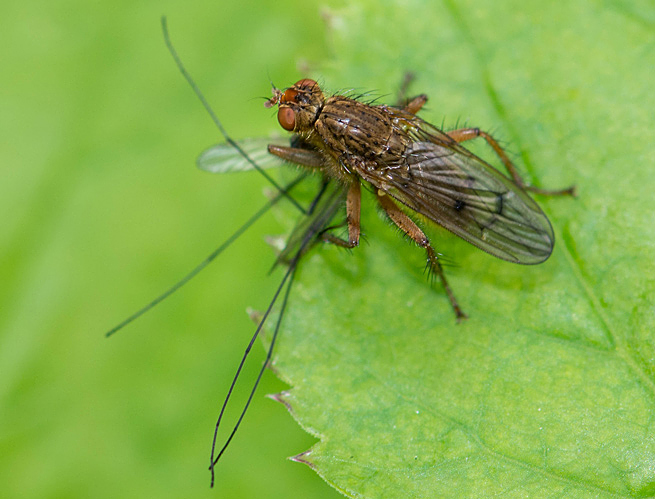
                                                                   Muscidae sp.
                                                      Hoverfly; Eristalis pertinax (Male)

So i spent a happy few hours seeking out the following insects, while still keeping an ear out for bird song.
Spring was late this year and might have had an effect on what I saw, so it will be interesting to find out over a longer period of time what can be found here and elsewhere in Shetland.
                                                        either A.cilipes or A.nebulosa


                                                         maybe a female Anthomyiidae
                                                          Hoverfly; Helophilus pendulus


                                                                   Garden Spider

Flowers always attract insects and a large number of large Marsh Marigolds hugged the little stream at the west end of the wood, Lesser Cellendine and Spanish bluebells could also be seen but the majority of wild garlic was yet to flower.
                                                            Hoverfly Rhingia campestris
 Hoverfly Rhingia campestris
                                                Scathophagidae; Scathophaga furcate

                                                     Scathophagidae; Scathophaga furcate

The tree cover can be quite dense in some parts so I concentrated on areas where light filtered through and also used fill in flash.
                                                             Hoverfly; Eristalis pertinax (male)

Thanks to Roger Thomason with the identification

Friday, 12 July 2013

Fetlar

Fetlar

It was nice to see my first photos on the Nature in Shetland website, one was this Red Throated diver below. These birds are easily seen at the Loch of Funzie from the roadside so no need to disturb the birds. This particular one looks like it is just about to start dancing, but in fact was about to get up out of the water to start its take off run.

A good range of birds can be seen on the island which is especially good for waders. On our first visit in 1987 we managed to see one of the Snowy Owls behind the school. Didn't do much after flying in, but it did show that it could look like a boulder and therefore blend into the landscape. Its a pity that Myxomatosis hit the island just after forcing the two birds to turn to Unst for food. What a great discovery by Bobby Tullock, showing that you too can still find things of interest.

Apart from the first year we visited the island, we have never seen Red Necked Phalaropes from the hide in the Mires, although this year it looked cleared of vegetation in some areas, so they might have borrowed an excavator that was doing some work towards the centre of the island. We have however seen and heard Water Rail and Reed Bunting, both uncommon during the breeding season. Red backed Shrikes have been found perching on fence posts near to the hide on two occasions.

Red Necked Phalarope used to be easy to see around the Lock of Funzie but over the past couple of years we have been lucky to see just one, a far cry from a few years ago when we saw 9 birds around the edge. They are so small people often miss them as they come very close to the shore line and are very confiding birds. Usually you can only see them from very late in May. One Phalarope was seen on Loch of Spiggie during June, well away from its normal breeding area.


In Sheffield we have had some special birds breed as well. In the city centre a pair of Peregrines have nested, the only city centre pair of Peregrines in Yorkshire and it has been great to see the parents feeding the 3 young which are normally sat on the Church tower. Peregrines are very rare breeding birds in Shetland with just one or two pair, unlike the rest of the UK where they have become more common.


The other special bird is the Black Redstart which has bred on a number of occasions but I have not heard about any in the last few year. I did however hear and see a male just before we went to Shetland, this time at the back of B&Q on Queens Road. I cannot believe that they are rare breeding birds in the UK given that they are very common in the rest of Europe.

Roof top gardens have been planted in several areas around Sheffield city centre to provide a habitat for insects and encourage Black Redstarts

Tuesday, 2 July 2013

Shetland Snow Buntings

June snow storm

From our  house in Sheffield it is 70 miles to the nearest coast, so we have to make a special journey to see Snow buntings in winter. Often travelling as far as Salthouse in Norfolk or into Lincolnshire to find these delightful birds. Often very confiding they can can also be encouraged to come closer by laying seed. We have only seen the odd summer plumage bird, the last one again at Salthouse which is also a favourite site with the birds and birders.

                                                                          Twite

During our time in Shetland this May and June we were lucky enough to come across a few birds. The first 3 very flighty birds down at Scatness in the South Mainland. These appeared on the wall to the south side before quickly disappearing towards the sea. They made a brief appearance before moving more inland, this was on the 26 May.

                                                          Compass Head Snow Buntings

At Grutness on the 30 May, a female was seen close to the gate leading to the tern colony. But the best views came on the 1 June at Compass Head when three Snow buntings were seen near the concrete slabs. Soon another couple of people arrived , one in a car and we set up using the car as cover. Seed was again laid and within 10 mins a couple of birds could be seen on the top of a building drinking water. They then flew down  to the seeded area where a Twite was already feeding, one bunting flew straight off leaving a superb male and a female close by. They edged closer giving great views before being chased by a low flying Gt Black Backed gull.


                                                      Compass Head Snow Buntings

We went to Fetlar on the 3 June, hoping to see Phalaropes down at Funzie. No immediate sign of the Phalaropes on arrival but my attention was drawn to a Whimbrel that landed close by. I then noticed several Dunlin feeding in a grazed area and was draw to a white bird that briefly emerged from behind a rock. This was another cracking male Snow Bunting. Then others appeared, another 2 males and 2 females that fed close together. I then crawled on my stomach for 20 yards through sheep poo to get closer. They were totally unconcerned as I lay close by and was able to get some close photos especially of the males.

                                                               Fetlar Snow Buntings

We stopped off at Brough Lodge watching Ringed Plover, Dunlin, Turnstone and several terns in the fog when a raptor came in off the sea. As it moved towards the Lodge we identified it as a male Marsh Harrier, an uncommon migrant up in Shetland, it soon moved off as it was mobbed by several gulls and Hoddie crows.

                                                                 Fetlar Marsh Harrier

While waiting for the return ferry I met up again with Martin Garner (Birding Frontiers), who also lives in Sheffield(didn't know at the time- its a small world),  who was eager to see the photos and suggested that on first glance they may possibly be the Siberian race Snow Buntings. I have since sent some photos to him to look at more closely, so I will let you know the outcome.


                                                                 Fetlar Snow Buntings

It would be very interesting if they are,  three races of snow bunting visit Britain. Greenland,  Icelandic and Scandinavian, with the Icelandic birds the most common. The Siberian race birds (ssp.vlasowae) have only been reported six times in Western Europe. 

Although no Snow buntings have been reported breeding in Shetland, two males and a female were present  on Ronas Hill from the 24 May - 12 July, with the males in song and alarm call heard suggesting a breeding attempt- Shetland Bird Club